
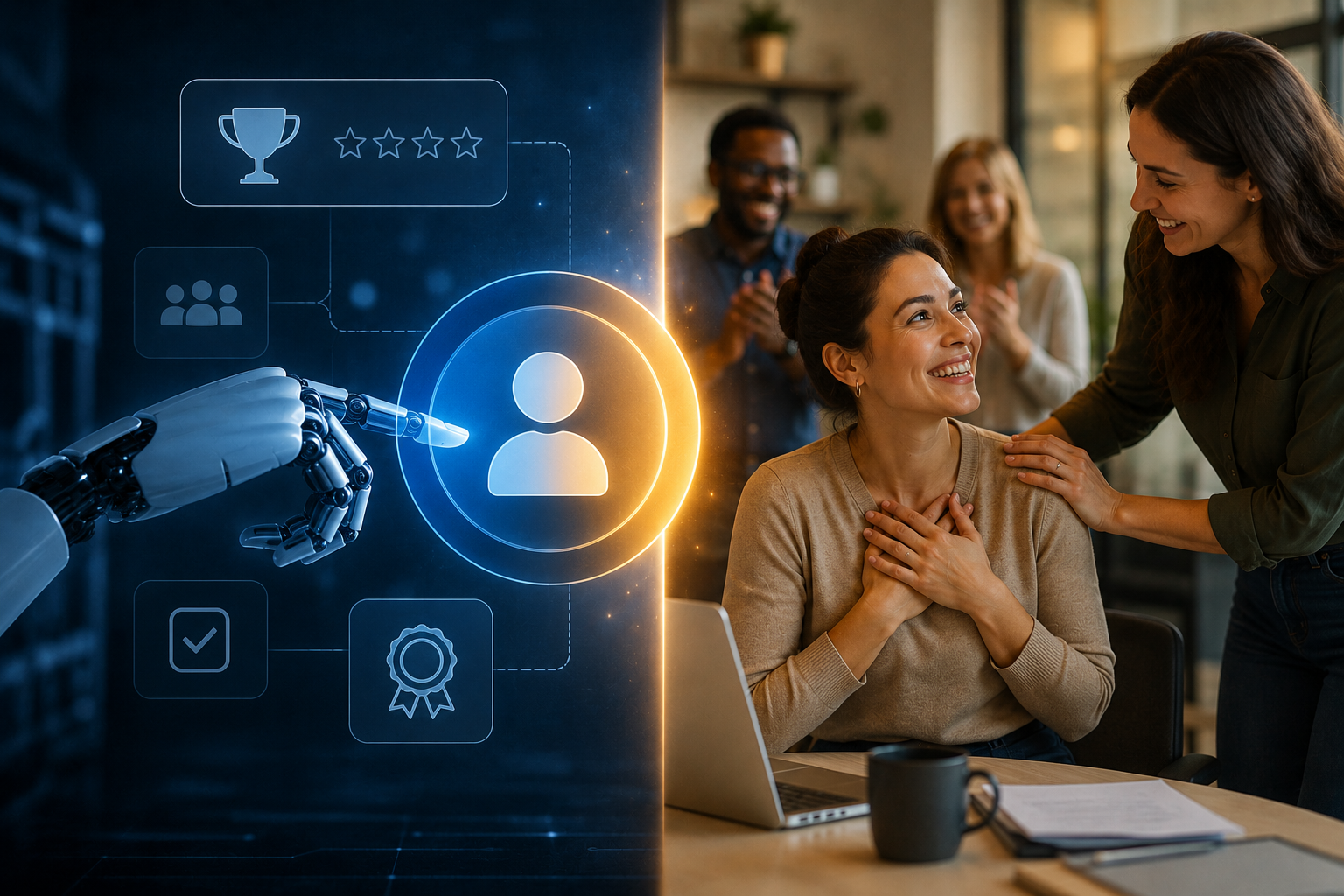
There’s a growing category of HR software that promises to use AI to recognise your employees. The pitch is appealing: the system monitors activity, identifies achievements, and sends personalised appreciation messages automatically. No manager time required. No awkward moments. Just a steady stream of recognition that never runs dry.
It sounds efficient. It is efficient. And for the employee on the receiving end, it is — once they realise what it is — almost completely hollow.
This isn’t a screed against AI in the workplace. AI tools for HR are genuinely useful for analytics, scheduling, workflow automation, and a dozen other applications. But recognition is different. Recognition is fundamentally a human act, and automating it doesn’t just reduce its effectiveness — it actively undermines the thing that made it valuable in the first place.
Here’s why.
In this article
- What peer recognition actually is — and what it isn’t
- The neuroscience: why the source of praise matters more than the praise itself
- The perception problem: how employees evaluate the authenticity of recognition
- What AI-generated recognition actually looks like to recipients
- The social function of peer recognition that AI cannot replicate
- Where AI genuinely helps — and where it genuinely doesn’t
- What good peer recognition looks like in practice
- Building a peer recognition culture that lasts
What peer recognition actually is — and what it isn’t
Peer recognition is the act of one employee acknowledging another’s contribution — publicly, specifically, and voluntarily. The three qualifiers matter.
Publicly because visibility amplifies the signal. A private message says “I noticed.” A public acknowledgement in the team channel says “I noticed and I want everyone else to know too.” That difference in social weight is significant.
Specifically because generic praise carries almost no information. “Great job this quarter” tells the recipient nothing about what they did that was valuable or worth repeating. “The way you restructured the client presentation to lead with the problem rather than the solution changed the outcome of that meeting” is specific enough that the recipient learns something about themselves, not just about how their manager is feeling.
Voluntarily because this is the quality that separates peer recognition from every form of structured appraisal or automated praise. Nobody asked the person to say this. They chose to. That choice is the entire emotional payload.
When AI generates a recognition message — even a well-crafted, personalised-sounding one — it removes the third quality entirely. It wasn’t voluntary. No human chose to notice and respond. An algorithm triggered a template. The employee didn’t receive appreciation; they received output.
The neuroscience: why the source of praise matters more than the praise itself
The brain’s response to social recognition is well-documented. When someone receives genuine appreciation from another person, the brain releases oxytocin — the neuropeptide associated with trust, social bonding, and wellbeing. This isn’t metaphorical. The neurochemical response to being genuinely seen by another human is real and measurable.
What’s less commonly discussed is that this response is highly context-sensitive. The same words, delivered by a stranger, produce a weaker effect than the same words from someone the recipient respects and trusts. A compliment from a senior colleague who rarely gives them lands differently than the same compliment from someone who gives them constantly. The brain is not just processing the content of the message — it’s processing everything it knows about the messenger, the context, and the likelihood that the message is genuine.
This is why peer recognition from a direct colleague often outperforms recognition from a manager in terms of emotional impact, even when the manager’s recognition is more formally significant. The colleague sees the work up close. Their appreciation carries the signal: someone who actually understands what you did thought it was worth acknowledging.
AI-generated recognition faces a fundamental problem here. Once an employee knows — or suspects — that the message they received was generated by an algorithm rather than chosen by a human, the neurochemical response changes. The signal that matters (someone noticed, someone chose to say something) is absent. What remains is information without meaning.
The perception problem: how employees evaluate the authenticity of recognition
Authenticity in recognition is not a binary — it’s a spectrum that employees are constantly, often unconsciously, evaluating. When someone receives appreciation, they process a series of rapid questions: Does this person actually know what I did? Did they have a reason to notice? Would they have said this if nothing had prompted them? Does the specificity of what they said match what actually happened?
This evaluation happens in seconds, but the conclusions it produces last considerably longer. Recognition that passes the authenticity test produces engagement and motivation. Recognition that fails it — even subtly — can actually be worse than no recognition at all, because it signals that the organisation views appreciation as a box to tick rather than a genuine human exchange.
Research consistently shows that employees are sophisticated detectors of inauthentic recognition. They notice when the timing is suspiciously regular. They notice when the language is templated. They notice when the appreciation covers something the sender couldn’t possibly have observed directly. And increasingly, they notice when the message reads like it was generated rather than written.
This perception problem is not going to improve as AI gets better at mimicking human language. It’s going to get worse. As employees become more aware of how AI recognition tools work — and as these tools become more widespread — the default assumption when receiving appreciation will increasingly be: was this a human or a system? Once that question exists in the recipient’s mind, even genuine human recognition starts to need to prove itself.
The answer is not to disguise AI-generated recognition more effectively. It’s to ensure that recognition in your organisation is visibly, demonstrably human.
What AI-generated recognition actually looks like to recipients
Consider the experience from the employee’s perspective.
You receive a message — in Slack, by email, on a recognition platform — that says something like: “Congratulations on completing the Q3 product launch! Your contributions to the team’s success have been outstanding. Your dedication and hard work are truly appreciated.”
The first read might feel good. The second read, if you think about it at all, starts to feel less good. Nobody on your team talks like that. The language is formal in a way that nobody in the office is formal. The achievement it references — “the Q3 product launch” — is accurate but strangely impersonal, as if it were pulled from a project management system rather than observed directly. And the praise itself — “outstanding,” “dedication,” “truly appreciated” — is the kind of language that appears in every recognition message, regardless of what the person actually did.
By the third encounter with this kind of message, employees have usually categorised it. It’s not recognition — it’s notification. The system has logged that something happened and generated an output to acknowledge it. That’s useful in the same way a confirmation email is useful. It is not the same as someone caring.
The most revealing data point here is how employees treat AI-generated recognition differently from human recognition. Human recognition gets shared — shown to a partner, posted in a personal channel, screenshotted and kept. AI-generated recognition gets skimmed and forgotten, in roughly the same way a marketing email gets skimmed and forgotten. The emotional half-life is dramatically shorter, and the behavioural change it produces — the motivation to repeat the recognised behaviour — is correspondingly weaker.
The social function of peer recognition that AI cannot replicate
Peer recognition does something that no form of automated praise can do: it publicly enacts a relationship.
When a colleague gives you recognition in a shared channel, they’re not just telling you something. They’re telling everyone something — about you, about their relationship with you, about what they value, and about the kind of team this is. The message is visible to people who weren’t part of the project, who don’t work closely with either of you, who might not even know each other well. It’s a social signal that travels across the organisation and does cultural work far beyond the dyadic exchange between giver and receiver.
This is why peer recognition is one of the most powerful mechanisms for communicating organisational values. When someone gives kudos and ties it to a company value — “this is what Ownership looks like” — they’re not just praising a colleague. They’re demonstrating, publicly, what that value means in practice. They’re telling every observer on the team: this is the kind of contribution we notice and reward here.
An AI system can generate a message that references a company value. It cannot enact the social relationship that makes the message meaningful. The difference between “our recognition platform has flagged this contribution as aligned with the Ownership value” and “my colleague chose to call this out and tell the team” is not a stylistic difference — it’s the entire substance of the thing.
Where AI genuinely helps — and where it genuinely doesn’t
Being precise about this matters, because the case against AI-generated recognition is not a case against AI in employee recognition altogether. AI tools for HR have genuine, significant value in the right applications.
Where AI adds real value in recognition:
Scheduling and automation of milestone celebrations — workiversaries, birthdays, service awards — is a genuine win for AI. These are date-triggered events where the value is in consistency and timing, not in the spontaneity or authenticity of the appreciation. An automated workiversary message that fires every year without anyone having to remember is strictly better than a workiversary that gets forgotten. The message doesn’t need to feel like it came from a human because the relationship it’s celebrating — tenure with the company — is structural rather than personal.
Analytics and culture insights are another legitimate application. AI tools that analyse recognition patterns across an organisation — identifying which teams are giving and receiving recognition, which values are being embodied, which individuals are going unrecognised — provide genuinely useful data that HR leaders can act on. The AI isn’t doing the recognising; it’s helping humans understand where human recognition is and isn’t happening.
Prompting and facilitation tools that help managers and peers express recognition more specifically and effectively are also useful — not replacing human appreciation but making it easier for humans who struggle with how to say something to find the words.
Where AI actively undermines recognition:
Generating appreciation messages on behalf of employees or managers, even if disclosed and edited, undermines the voluntary quality that makes recognition meaningful. The moment a manager relies on AI to write what they say to a team member, the authenticity of the message is compromised — not because the AI wrote badly, but because the manager’s contribution was to click approve rather than to choose to say something.
Scaling recognition through automation — sending more messages to more people more often through AI generation — produces diminishing returns that eventually turn negative. More is not better if more means less human. An organisation that sends 100 AI-generated recognition messages a month produces less engagement than one that sends 20 human ones.
What good peer recognition looks like in practice
Understanding why human recognition beats automated praise is useful. Knowing what good human recognition looks like in practice is more useful.
It’s specific about the action, not the outcome. “You shipped the feature” is an outcome. “The way you handled the API design decision when the third-party integration changed two days before launch — that’s what saved the timeline” is the action. Outcomes are visible to everyone; the action is what the recogniser actually witnessed.
It connects the action to its impact. “That prevented a delay that would have cost us the client presentation slot” closes the loop between what the person did and why it mattered. Peer recognition without impact is a compliment. Peer recognition with impact is evidence.
It’s given at the moment of recognition, not deferred. The further recognition is from the act it’s recognising, the weaker its effect. A kudos given the day something happened is significantly more powerful than the same kudos given at the quarterly all-hands. Real-time tools — Slack, MS Teams, peer recognition platforms that live in the flow of work — close this gap.
It’s genuinely optional. The manager who builds a habit of noticing and naming specific contributions, without being required to, is doing something categorically different from the manager who fills out the recognition form because HR set a monthly target. The employee knows the difference immediately and responds accordingly.
It names a value without being preachy. “This is what Customer First looks like, and you did it perfectly” is specific, genuine, and connects behaviour to culture in a way that lands. “You really embodied our core values today” is vague enough to have come from any recognition platform in the world.
Building a peer recognition culture that lasts
The most effective peer recognition cultures share one characteristic: recognition happens in the tools where work already happens. Not in a separate platform that requires a login and a form. Not in a quarterly ceremony. In the same channel where the team discusses the project, reviews the PR, and shares the update.
This is why peer recognition built into Slack and MS Teams produces consistently higher adoption than standalone recognition platforms. The friction of context-switching is enough to turn “I noticed something great and I should say so” into “I’ll do it later” and then nothing. When the mechanism is as simple as @name++ in the same channel where the conversation just happened, the decision to recognise becomes as easy as adding a reaction.
What Karma does is provide the structure around that human impulse — the karma points that accumulate toward real rewards, the value tags that connect recognition to culture, the analytics that show leadership where recognition is happening and where it’s absent — without replacing the human impulse itself. The system makes it easier for humans to recognise each other. It doesn’t recognise on their behalf.
That distinction is the whole thing. An AI that recognises employees is a notification system dressed in appreciation language. A platform that makes it easier for humans to recognise each other is an amplifier for the most powerful engagement driver available: genuine human appreciation, given voluntarily, from someone who actually saw what you did.
The teams that get this right — that build peer recognition into the daily rhythm of work, that make it easy and visible and genuinely human — are the ones where people feel seen not just at their annual review but on a Tuesday afternoon after solving a problem nobody else noticed.
That’s what retention looks like at the team level. And no AI generates it. Humans do.


 Workiversary: What It Means, How to Spell It, and 40 Ways to Celebrate It Right